
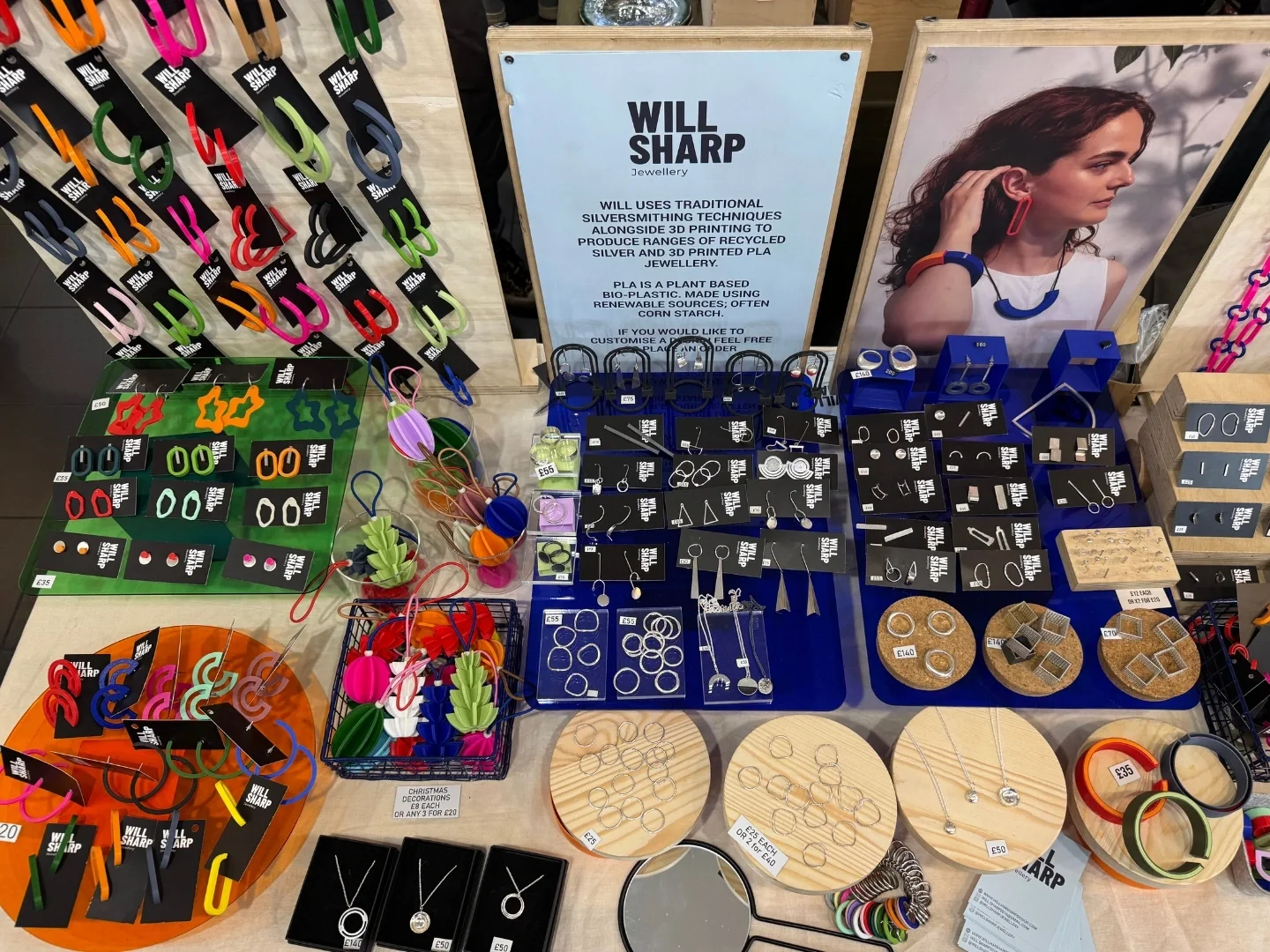
Will Sharp Jewellrey – Market stall setup
Having curated makers’ markets events in London since 2019, over the years I’ve seen thousands of visitors mooch around our markets – sometimes making a beeline straight for a table because of something super eye-catching, other times hovering at a distance clearly unsure about approaching; I’ve seen stallholders who are expert at genuine conversations fuelled by small talk, funny stories or interesting info… Interactions that sometimes turn instantly into a sale… And sometimes not.
One thing I’ve noticed is that two stalls can be selling equally beautiful work, yet one has people gathered around it all day while the other barely gets a second glance.
The difference usually isn’t the product.
It’s the way the stall works as an experience ✨
After seeing a couple of thousand table setups over the years – the brilliant ones, the unplanned ones, the understated ones, and the ones that steadily improve every time a maker joins us – there are a few patterns that come up again and again.
If you’re preparing for a market and wondering how to stand out, these are the things that actually make a difference.
FOUR COMMON MISTAKES I SEE ALL THE TIME
1. No signage
This one surprises me every time.
A lot of stalls don’t clearly show:
• the maker’s name
• their social handles
• how to buy online later
• info about what the work is (materials, processes, backstory)
If someone falls in love with your work, you want to make it really easy for them to find you again.
This doesn’t have to be fancy. It could literally be a nicely printed sheet with a QR codelinking to your socials. Or something handmade like screenprinted fabric or a stitched banner.
The key thing is to simply avoid making people guess who you are.
2. Everything sits flat on the table
First-time exhibitors often arrive with a tablecloth/fabric to lay their work out on, but haven’t considered creating height variation … And the whole display ends up completely flat.
While flat displays can work depending on what your work is, they don’t always – sometimes flat displays can actually be surprisingly hard for the eye to navigate.
Adding height often makes a massive difference.
This could done using things like:
• boxes or plinths
• clothing rails
• display cases
• grid mesh walls
• jewellery stands
• small shelving
I’ve even seen people place boxes underneath their tablecloth so the fabric drapes over them and creates little hills and levels.
It turns a flat surface into something that feels like a little landscape.
3. No clear story
Your stall is basically a tiny exhibition of your work.
And like any exhibition, it benefits from having some sort of visual logic behind it.
Maybe the story is based on:
• the materials you work with
• your focus on sustainability
• your work’s theme (e.g. food, the seaside, bugs, kawaii)
• craft traditions
• nature
• the bold colours or shapes that characterise your work
Everything on your display can contribute toward tell the story before you even utter a word – the tablecloth, props, photography, sketchbooks, tools, packaging, signage, etc.
Not too long ago, I stopped to chat with a jewellery maker whose pieces were incredibly colourful, poppy and geometric.
The jewellery was fun, beautiful and skilfully made… But the display just didn’t reflect this – a dull-coloured tablecloth, natural-wood props and generic backing cards to display the jewellery on – which, in my opinion, really cheapen the work and instantly makes my brain think “mass produced“.
We ended up brainstorming visual merchandising ideas right there at the market (which I absolutely LOVE doing). I suggested things like making her own brightly-colouredplinths and risers; cutting colourful shapes out of acrylic, wood or even paper, basing them on the shapes she uses in her work; playing around with how her work is organised on the table (e.g. by colour, collection or price point). I also recommended ditching the backing cards and displaying the jewellery without to elevate her work.
Even small tweaks can suddenly make the work feel much more alive, appealing and valuable.
4. The busy/overloaded tabletop
This one’s really common.
People understandably want to show everything they’ve made… But to me, the result can sometimes make me react the same way I always do when I open a 10-page restaurant menu. My brain just goes:
Nnnnope.
When I’m overwhelmed I’d much rather ask the waiter what they recommend.
The same thing happens at stalls.
If a table is completely packed with work, it’s hard for visitors to focus on anything. Creating spaceand flow between pieces and collections helps people notice your work properly and navigate the tablescape with ease.
Interestingly also, a more minimal display often makes handmade work feel more valuable – more handmade, less mass-produced.
THREE STALLS I STILL THINK ABOUT MANY EVENTS LATER
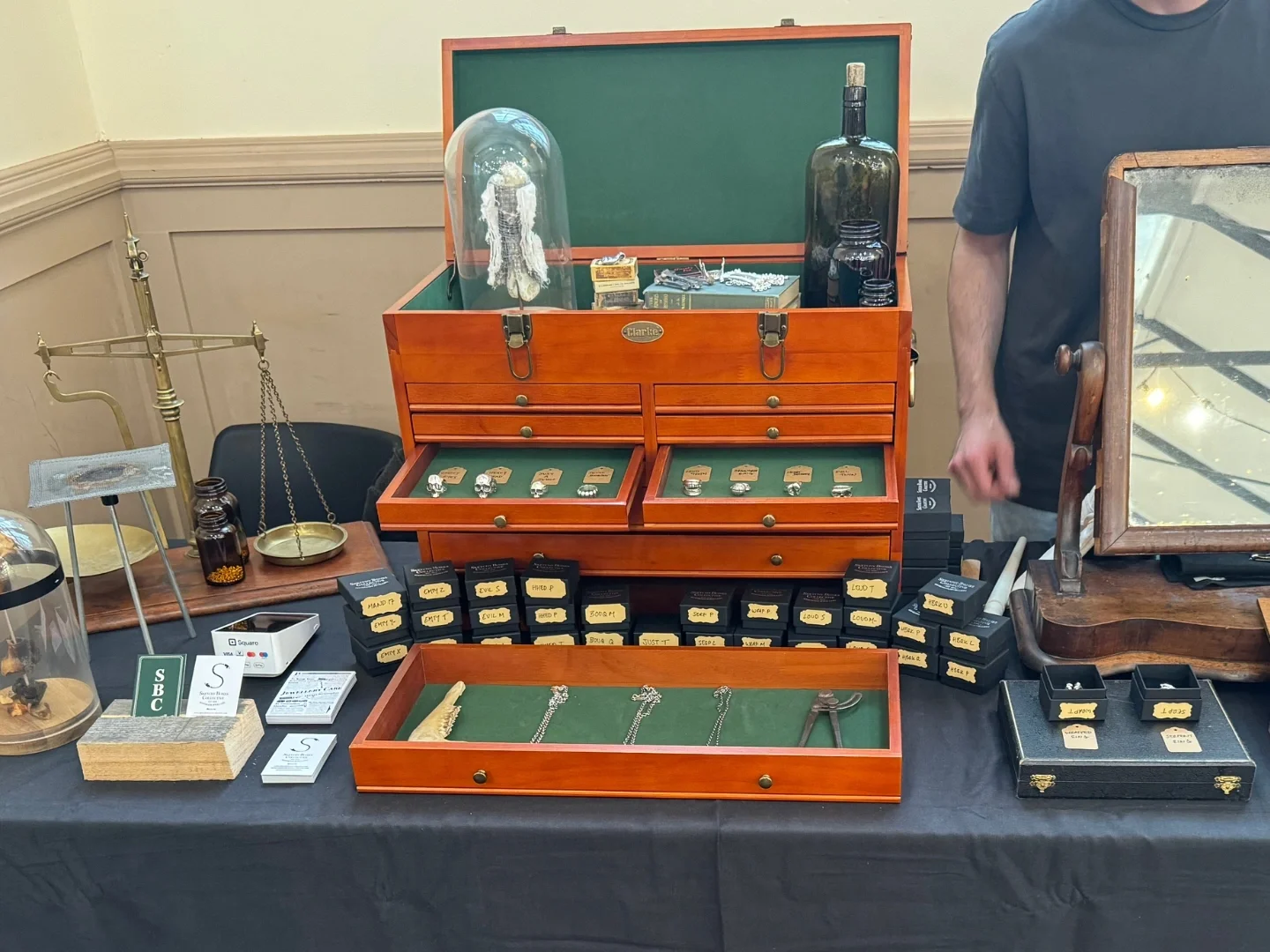
Sketchy Bones Collective
London-based founder, Cen, creates anatomical jewellery exploring resilience, fragility and mortality.
His stall looks evokes Victorian apothecary.
At the centre sits a heavy antique wooden case displaying the jewellery. Around it are:
• Victorian medicine bottles
• bell jars
• antique scales
• surgical instruments
Each piece has a small, handwritten cardboard tag tied on – much like those you’d find tied to a toe at a mortuary.
It’s theatrical, slightly macabre, and so exquisitely aligned with the concept of the work.
People flock to this stall because it creates drama – it’s really like you’re stepping into a new (old) world.
Kitschen Jewellery
Kitty creates nostalgic food-inspired jewellery based on the comforting familiarity of everyday meals.
Her stall storytelling is brilliant.
The tablecloth is red-and-white gingham, instantly evoking London caffs and picnic blankets: it shouts FOOD.
Two brushed-gold mushroom lamps (another subtle food nod) frame the display and cast a warm glow across the table.
The pieces themselves are displayed very minimally, with a simple sign explaining:
Handmade Food-Inspired Jewellery.
Visitors instantly understand what they’re looking at – and it inevitably leads to chats about food nostalgia.
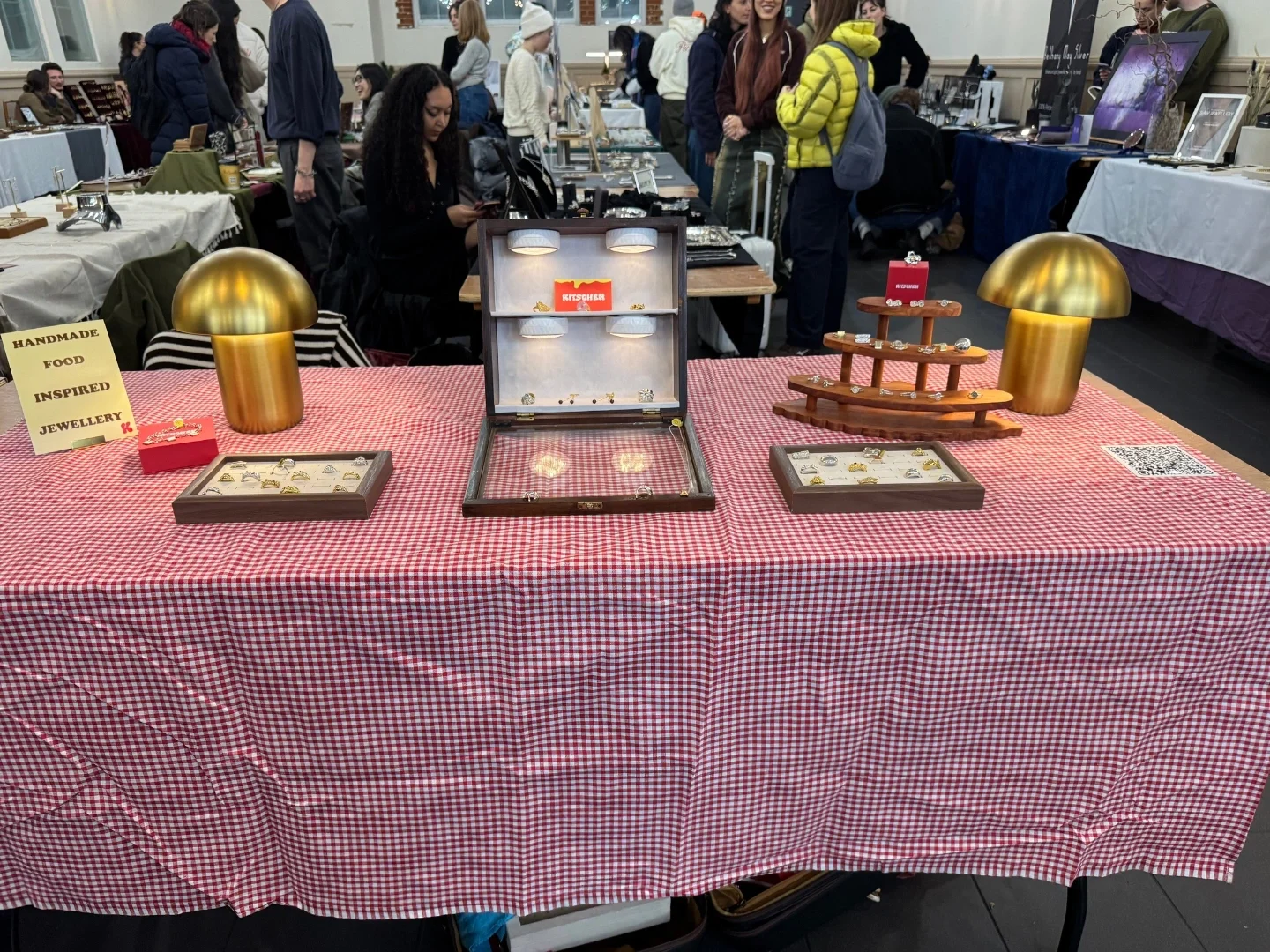
Kitschen Jewellery – Visual merchandising
Gracie Roving Knitwear
Gracie’s setup was a masterclass in thoughtful simplicity.
Because her knitwear is made to order, she brought just one of each design – in a range of sizes – and spaced them evenly along a clothes rail.
A small table beside the rail explained how customers could pre-order.
Each garment had a beautifully printed tag attached with wool and a tiny safety pin – placed in exactly the same spot on every piece. Opposite this, there was another tag, clearly displaying sizes, with garments arranged in size order, and the best-seller at the front.
To read the tag, visitors had to come up close and touch the garments.
And once people came and interacted with the knits and got to feel the quality, conversations started naturally.
… And if that wasn’t enough – Grace brought her own full-length mirror – a subtle invitation to customers that they’re welcome to try her knits on (you’d be surprised how many fashion makers/brands don’t bring a mirror!)
She left her first ever market with multiple pre-orders.
Grace was very intentional in her approach and prepared masterfully – incredible work for a first timer!

Gracie Roving Knitwear – Pitch setup
HOW TO DESIGN A GREAT MARKET STALL (STEP BY STEP)
If you’re not sure where to start, here’s a simple framework.
1. Decide the story of your work
What ideas or feelings define your work?
2. Choose materials that support that story
3. Add two or three height elements
Shelves, boxes, stands or rails.
4. Include one conversation starter
A tool, sketchbook/journal, prop or interactive element.
5. Test the layout at home first
When people search online for craft fair display ideas, what they’re usually trying to figure out is exactly this – how to make their stall visually interesting and easy to browse.
SMALL THINGS THAT MAKE A BIG DIFFERENCE
Create conversation starters
Small interactive elements can make it easier for visitors to start chatting.
For example:
• a ring sizer
• an open sketchbook showing your process
• tools used in your craft
• a bowl of sweets
• a pick-and-mix tray of small items
• you could even be making or finishing pieces during the market – people LOVE to see it!
These little prompts invite curiosity.
Encourage people to touch your work
When someone picks something up, the chance of a sale increases dramatically.
Touch helps visitors:
• feel the quality
• imagine owning the piece
• connect emotionally with it
Sometimes even placing price tagsunderneath pieces can encourage this interaction – they can see the price tag peeking out, which silently invitesinvestigation. Alternatively, you can let people know “the pricing is underneath”.
A lot of guides about how to sell at a craft market focus purely on pricing or product range, but in reality sales often start with conversation.
A CONTROVERSIAL OPINION ABOUT PRICE TAGS
A lot of people will disagree with me on this, but that’s cool 😎
… But personally, I’m really not convinced that big, very visible price tags are helpful.
Pricing absolutely needs to be available – people should never feel awkward asking.
But when prices are extremely prominent, visitors sometimes make a snap judgement and don’t even approach.
If pricing is slightly subtler – maybe on a turned-over tag or underneath the piece – visitors feel more comfortable to approach knowing they can pick up the work to check for themselves without getting into a conversation (lots of people worry they’ll be expected or end up feeling guilty and pressured to buy).
That smallinteraction can easily turn into a conversation, which is usuallywhere sales begin.
WHAT VISITORS ARE REALLY LOOKING FOR
People don’t just come to makers markets to buy things.
They come for connection, authenticity and provenance.
They want to:
• meet the maker
• hear the story behind the work
• learn something interesting
• feel part of a creative community
… In a world dominated by mass production and online shopping, markets offer something rare:
authentic human interaction.
Sometimes someone buys something not only because they’re drawn to the work – often the thing that pushes them over the line is the fact they’ve had a lovely conversation with the maker. I know I often do.
And those conversations are often what people remember long after the market ends.
WHAT TO BRING TO A MAKERS MARKET STALL
This is one of the most common questions first-time exhibitors ask.
A simple packing list:
Display
• tablecloth
• display stands or shelving
• signage
• business cards or a QR code linking to your socials/website
• props
Payments
• card reader
• phone charger or power bank
• cash float
Practical things
• scissors
• masking tape
• pens
• string/twine
• packaging
Personal things
• snacks
• water
• comfortable shoes
Markets are long days – being prepared makes everything smoother and way easier!
This kind of preparation is often included in guides about craft fair stall setup, but it applies just as much (if not more) to contemporary makers markets.
QUICK CHECKLIST BEFORE YOUR NEXT MARKET…
Before your next event, ask yourself:
• Can visitors clearly see my brand name?
• Does my display have height and structure?
• Is there a clear story behind the setup?
• Is my table easy to browse (not overcrowded)?
• Does my tabletop have something that sparks conversation?
• Can people easily find me online afterwards?
WANT TO TRADE AT A MAKERS MARKET IN LONDON?
We host curated pop-ups through N4 Makers’ Market in London, showcasing independent artists and designer-makers.
If you’re interested getting involved in a future market, you can apply to exhibit at one of our curated London makers’ markets.
Upcoming makers markets in London:
Indie Jewellers Market
Illustration + Print Show
Ceramicists’ Mart
Slow Fashion + Knitwear Fair
